A wardrobe can solve office storage problems, but only when its internal layout, access, security, ventilation, materials, and placement match the work being done. By the end, you will be able to test whether a wardrobe fits your workspace, compare it with other storage formats, calculate what it must hold, and prepare the measurements and specifications needed before ordering.
Key takeaways
- Match shelves, drawers, rails, and locks to the items employees store.
- Measure wall width, ceiling height, door swing, sockets, and circulation space first.
- Check moisture, wall stability, ventilation, anchoring, and fire-safety clearances.
- Give your designer a room plan, inventory, access needs, and finish preferences.
When an Office Wardrobe Is the Right Storage Format
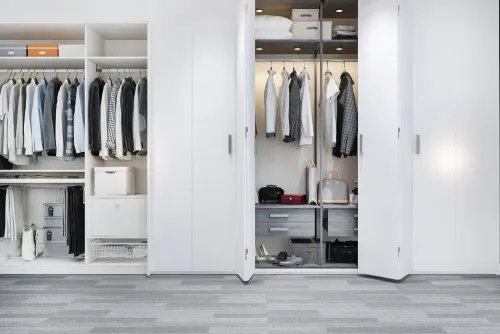
A wardrobe suits an office when the main need is to store coats, bags, uniforms, stationery, personal belongings, archive boxes, or closed records. A wardrobe for office workspace in Thane becomes useful as a modular storage wall when shelves, locks, and compartments match the work rather than simply copying a bedroom cabinet.
It does not automatically replace a filing cabinet, locker, credenza, equipment cupboard, or open shelving. Compare the formats before choosing an office wardrobe in Thane.
| Option | Storage type | Access | Visibility and lockability | Footprint |
|---|---|---|---|---|
| Wardrobe | Mixed shelves, drawers, and hanging space | Shared or assigned sections | Closed and lockable; hides clutter | Tall wall storage; doors need clearance |
| Filing cabinet | Folders and active records | Usually individual or team access | Closed, with purpose-built file drawers and locks | Smaller floor footprint; limited item flexibility |
| Locker | Personal bags, coats, or uniforms | Individual access | Closed and lockable | Repeated narrow units; efficient for staff belongings |
| Credenza or open shelving | Supplies, equipment, and frequently used files | Shared, quick access | Visible; open shelving exposes clutter and records | Lower or shallower storage; easier reach |
Use hinged doors on a wide wall run with clear standing space. Sliding doors prevent door-swing conflicts with desks or walkways, but users still need room in front to stand and retrieve items. Drawers suit small stationery and personal items; adjustable shelves accommodate changing file, sample, helmet, and laptop-bag sizes.
Choose another format when rapid individual access, heavy equipment, or visible active files dominates the workflow.
Design the Interior Around People, Files, and Equipment
Divide the wardrobe into three access zones so users do not compete for one oversized compartment:
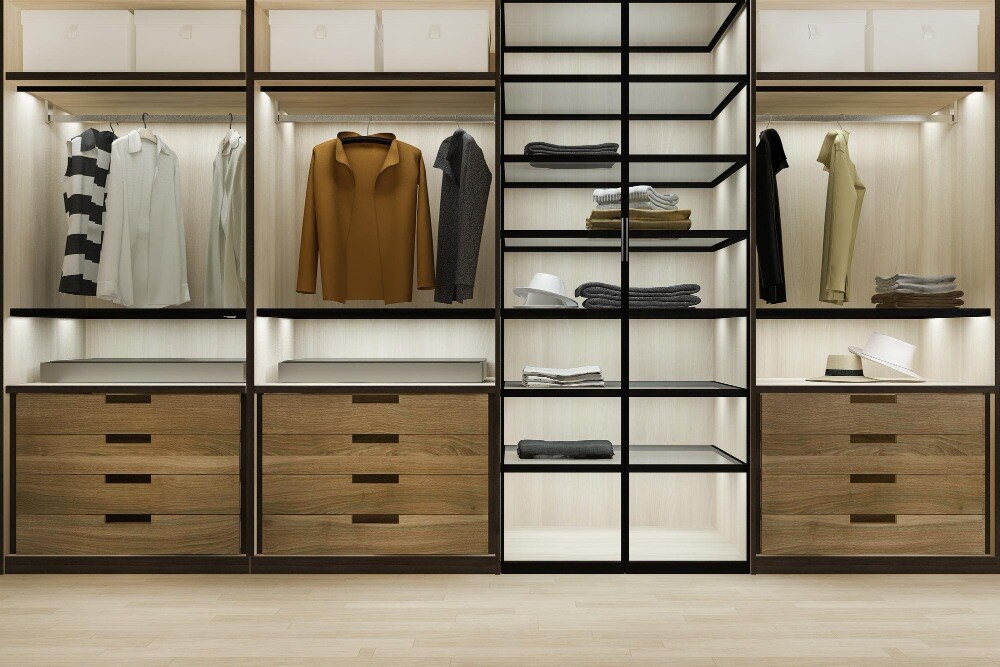
1. Open storage for daily stationery, forms, files in use, and frequently used supplies. Use adjustable shelf-pin holes at regular intervals and specify shelf widths that match the items, rather than forcing folders and cartons onto one deep shelf.
2. Lockable storage for confidential records, personnel files, and controlled documents. State the drawer count, lock locations, removable panels, and who receives keys. A cabinet lock is not a certified safe or security cabinet; do not use it for high-value assets without the required security rating.
3. Restricted compartments for printers, UPS units, routers, tools, or controlled supplies. Provide cable openings, ventilation openings, and dust protection. Sealing warm equipment inside a bedroom-style compartment raises operating temperature and shortens equipment life.
Put heavy files, UPS units, and equipment in lower storage to reduce tipping and shelf stress. Distribute loads across shelves and specify stronger shelf construction where cartons or equipment are dense.
For shared offices, record whether each compartment uses an individual key, master key, replacement-key system, or digital-lock battery-failure override. A missing plan can leave confidential files inaccessible.
Workspace storage furniture in Thane should screen clutter without pretending to provide soundproofing. A full-height wardrobe hides desks visually; it does not replace a tested acoustic partition. Include these requirements in a custom office storage in Thane brief.
Measure the Room Before You Choose the Cabinet
A 550–600 mm-deep bedroom wardrobe can consume a significant circulation strip in an office. Measure the room before specifying modular furniture for offices in Thane, then test the cabinet with every door, drawer, and basket fully open.
- Record wall width, ceiling height, floor level, skirting depth, wall straightness, columns, windows, door swing, desk position, and passage width.
- Mark electrical outlets, switchboards, air-conditioning units, damp zones, fire equipment, and access panels.
- Measure the clear route from delivery entrance to the installation wall, including turns and lift or stair openings.
| Storage feature | Clearance or check | What can go wrong |
|---|---|---|
| Hinged shutters | Full door width plus standing space | An open door blocks desks or the passage |
| Drawers and pull-out baskets | Complete extension clearance | Users cannot retrieve contents safely |
| Sliding shutters | Accurate, level tracks and front standing space | Misaligned tracks jam, and poor access hides maintenance problems |
Plan capacity against employee count, file volume, shelf width, drawer count, and available wall length. A narrow office wardrobe in Thane may hold personal items efficiently but fail when files, equipment, or bags exceed its shelf dimensions.
For a design consultation, provide a floor plan, photographs of outlets and obstructions, equipment dimensions, user count, storage categories, and security needs. Include the open-door clearances, not only the cabinet’s closed footprint.
Check Moisture, Stability, Ventilation, and Building Safety
Thane’s monsoon humidity and rain exposure make sealed edges, moisture-resistant construction, and a dry wall and floor essential. Damp walls can swell boards, loosen finishes, promote mould, and corrode hardware. Check the wall and floor before installation, not after the cabinet shows damage.
| Board type | Standard to discuss | Key limitation |
|---|---|---|
| Interior-grade plywood | IS 303, general-purpose plywood | Needs sealed edges and protection from damp areas |
| Marine plywood | IS 710, marine plywood | Resists moisture better but is not waterproof when poorly sealed |
| Particleboard | Confirm its moisture rating | Unsealed edges can swell quickly after water exposure |
Your specification must state the board type, thickness, edge-banding method, and surface finish. Marine plywood does not make an improperly sealed cabinet waterproof. Provide ventilation around routers, UPS units, printers, or other heat-producing equipment instead of enclosing them in a tight, unventilated box.
For custom office storage in Thane or workspace storage furniture in Thane, complete this safety check:
- Measure the clear opening of every route used to deliver and install the unit.
- Inspect the installed unit with every door and drawer fully open.
- Anchor or otherwise restrain tall, narrow, or heavily loaded units; place heavy files and equipment in lower compartments.
- Keep exits, stairs, fire extinguishers, electrical distribution boards, fire doors, and service panels accessible.
A corridor, reception path, or exit-side position needs stricter review than a normal wall. Check the building handbook, fit-out rules, approved fire-safety plan, and National Building Code of India Part 4 with the facility manager or a licensed fire-safety professional. If the cabinet conflicts with an escape route, choose another location or storage type.
Turn the Site Check Into a Custom Storage Brief
A usable brief names the constraints before anyone chooses a finish or door style. Record the following before requesting modular furniture for offices in Thane:
- Intended location, wall length, floor condition, and circulation width
- Storage categories, number of users, employee belongings, and daily access frequency
- File dimensions, archive-box sizes, stationery, uniforms, bags, and cleaning supplies
- Printer, UPS, router, or other equipment heat, ventilation, and cable-opening needs
- Required lockable sections and who controls keys, codes, or replacement locks
- Door type, shelf adjustability, drawer requirements, and lower compartments for heavy loads
- Wall restraint, sealed edges, moisture protection, and access for cleaning or repairs
- Building approval, fire-safety restrictions, exit clearance, and service-panel access
Compare the proposal against the actual work, not against a bedroom wardrobe.
| Option | What to compare | Reject it when |
|---|---|---|
| Closed wardrobe | Personal items, files, and visual control | Users need constant open access |
| Open shelving | Fast shared retrieval | Clutter or confidential records are exposed |
| Lockable cabinet | Confidential files or controlled supplies | One lock forces unrelated users to share access |
| Equipment module | Heat, ventilation, and cables | The compartment is sealed |
Radiant Kitchen Studio can discuss custom office storage in Thane when you bring site measurements, the floor plan, photographs, storage inventory, and access requirements. A wardrobe for office workspace in Thane earns its space only if it holds the required items, supports movement, preserves maintenance access, and meets premises rules.
If the survey reveals an exit, equipment, or service conflict, change the location or storage format.
Related products
 | Modular Furniture Radiant Kitchen Studio, located in Thane, offers stylish, functional, and customized modular furniture solutions designed to enhance modern homes and... View product → |
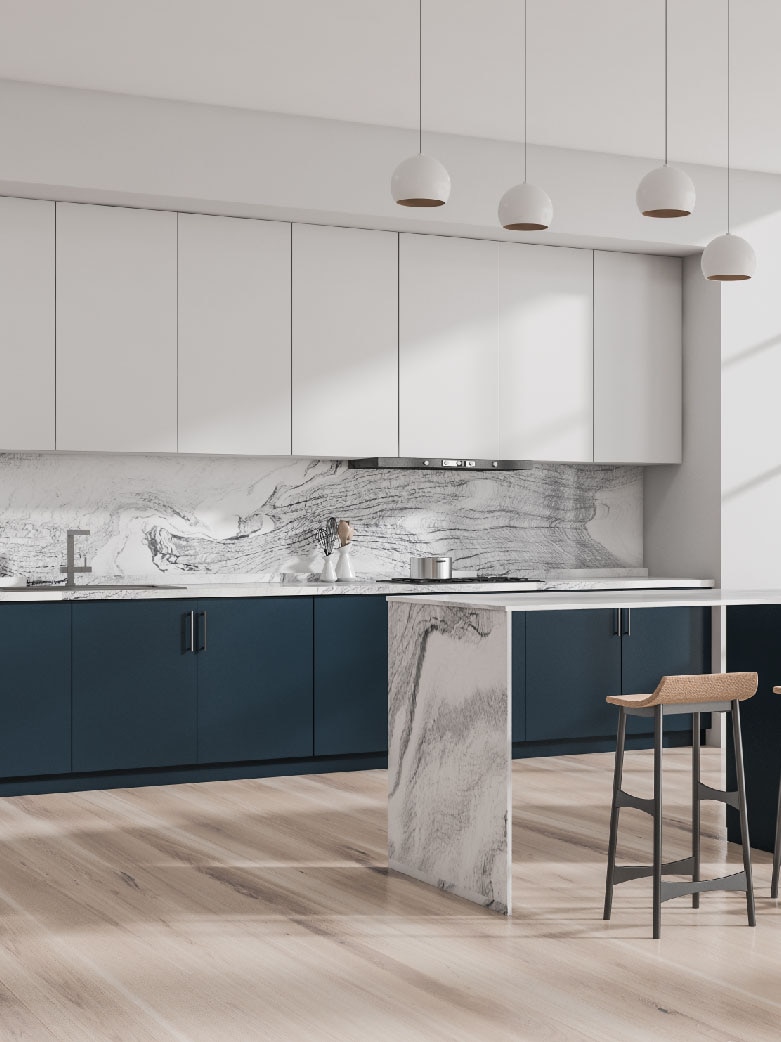 | Modular Kitchen Radiant Kitchen Studio in Thane specializes in designing stylish, modern, and functional modular kitchens tailored to the unique requirements of... View product → |
Frequently asked questions
When is a wardrobe the right storage format for an office?
Use a wardrobe when you need closed storage for coats, bags, uniforms, stationery, archive boxes, personal belongings, or records. It works as a storage wall when its compartments match the office’s daily tasks.
What should an office wardrobe store?
Plan the interior around the actual inventory: adjustable shelves for files and boxes, rails for coats or uniforms, drawers for stationery, lockable sections for records, and ventilated space for equipment that produces heat.
What should you measure before choosing an office wardrobe?
Measure wall width, ceiling height, skirting depth, door and window positions, sockets, switches, access routes, door swing, and the clear walking space in front of the cabinet.
What safety checks should you make for office storage in Thane?
Check for damp walls, uneven floors, stable fixing points, ventilation around equipment, safe door operation, anchoring requirements, and clearance from fire exits, sprinklers, electrical panels, and escape routes.
Keywords